One founder. A whole team at work.
Human–AI Systems runs on its own Business AI Operating System. A named AI team handles marketing, sales, operations, finance, technology and delivery, around thirty routines run every day without being asked, and a human stays in charge of the decisions that matter. This page shows what that looks like in practice.


Every founder’s real job is building a strong team.
Anyone who has built a business learns it early: you are only as good as the team around you. Mine is an AI team that I lead, working alongside human partners who bring skills, relationships and judgement of their own.
Each AI team member has a defined role, knows the business in depth, and works to the same standards and the same brand. I set the direction, own the client relationships and make the decisions that matter. It is the model we help clients adopt: human leadership, AI workers in defined roles, and governance built in from the start.
This team gets better without being replaced. Every time the underlying AI models improve, every member of the team improves with them. On top of that, the operating system itself improves every week, as corrections are folded back into the skills and new knowledge compounds. Continuous improvement is built into how the team works.
Our reference company, Lumen, shows the same idea across a 400-person organisation.

Four parts, one platform, a human in charge.
Every Business AI Operating System has the same four parts. Here is what each one holds at Human–AI Systems. Step through it.
Most of the routine work is done before I start.
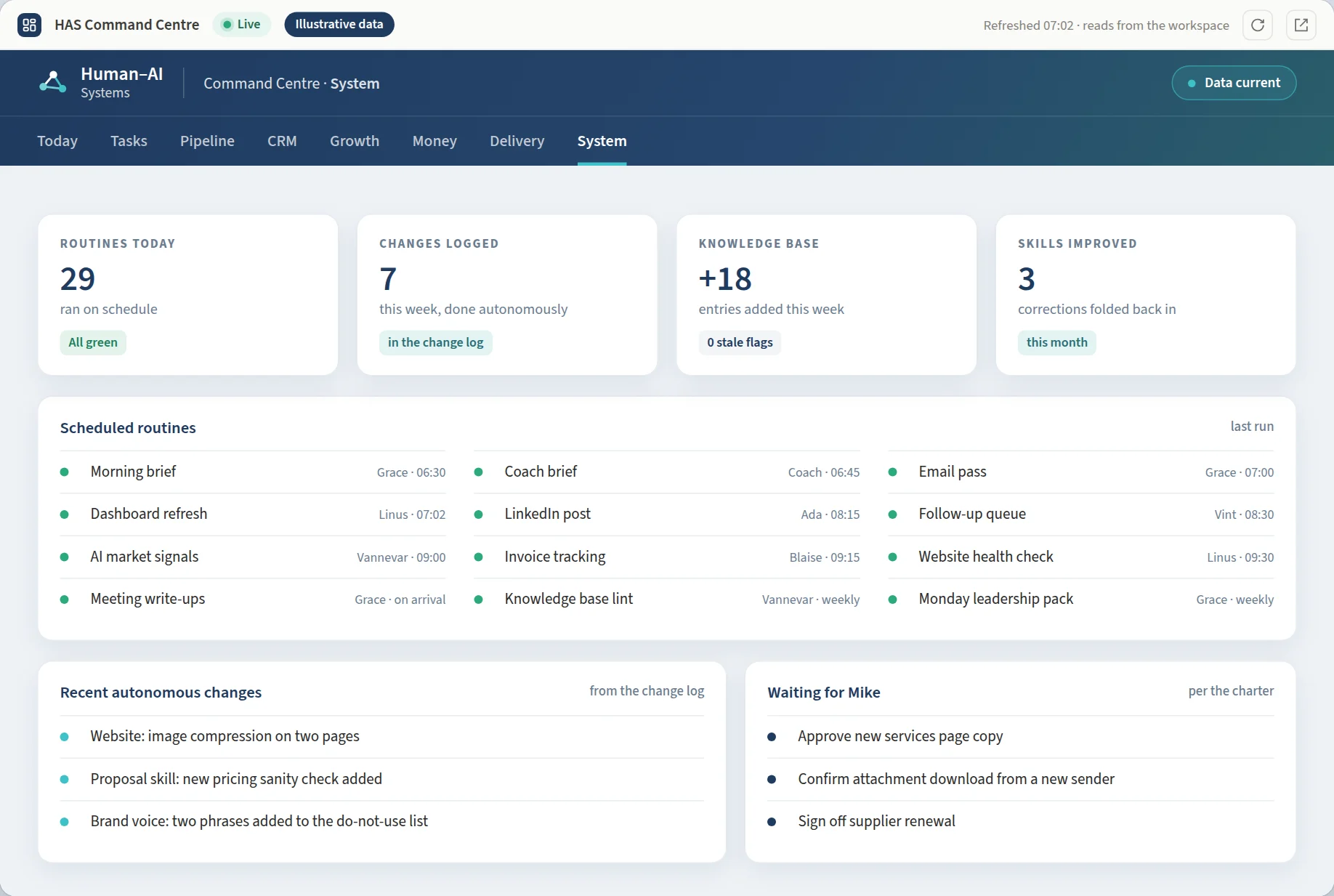
Around thirty routines run on a schedule. None of them waits to be asked, and everything they produce is written back into the knowledge base, so tomorrow starts from where today finished.
The brief is waiting
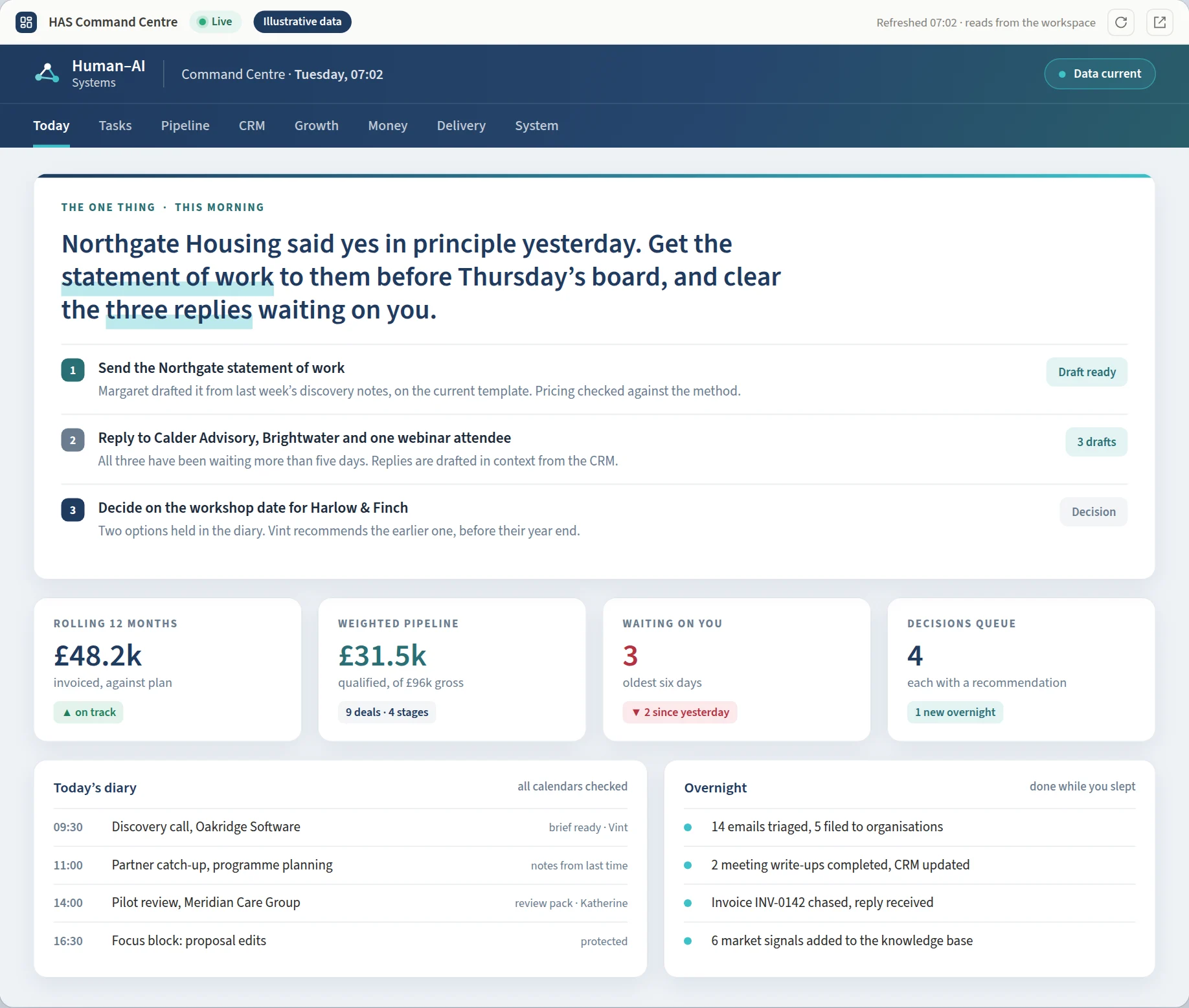
Grace prepares the morning brief: today’s diary across every calendar, what arrived overnight, overdue tasks and the decisions waiting. The AI coach adds what matters most today and whether the plan fits the goals.
The inbox is triaged
Email passes file, label and draft replies in context. Follow-ups go out on time, LinkedIn content is prepared and published, invoices are tracked and chased, and the dashboards refresh.
The write-up is done
Notes, actions and recommended next steps, filed against the right organisation, with the CRM updated. There is no separate admin session afterwards.
The system checks itself
Market intelligence is refreshed, the knowledge base is checked for anything stale or missing, the website and scheduled routines get a health check, and a leadership pack is ready on Monday.
One screen for the whole business.
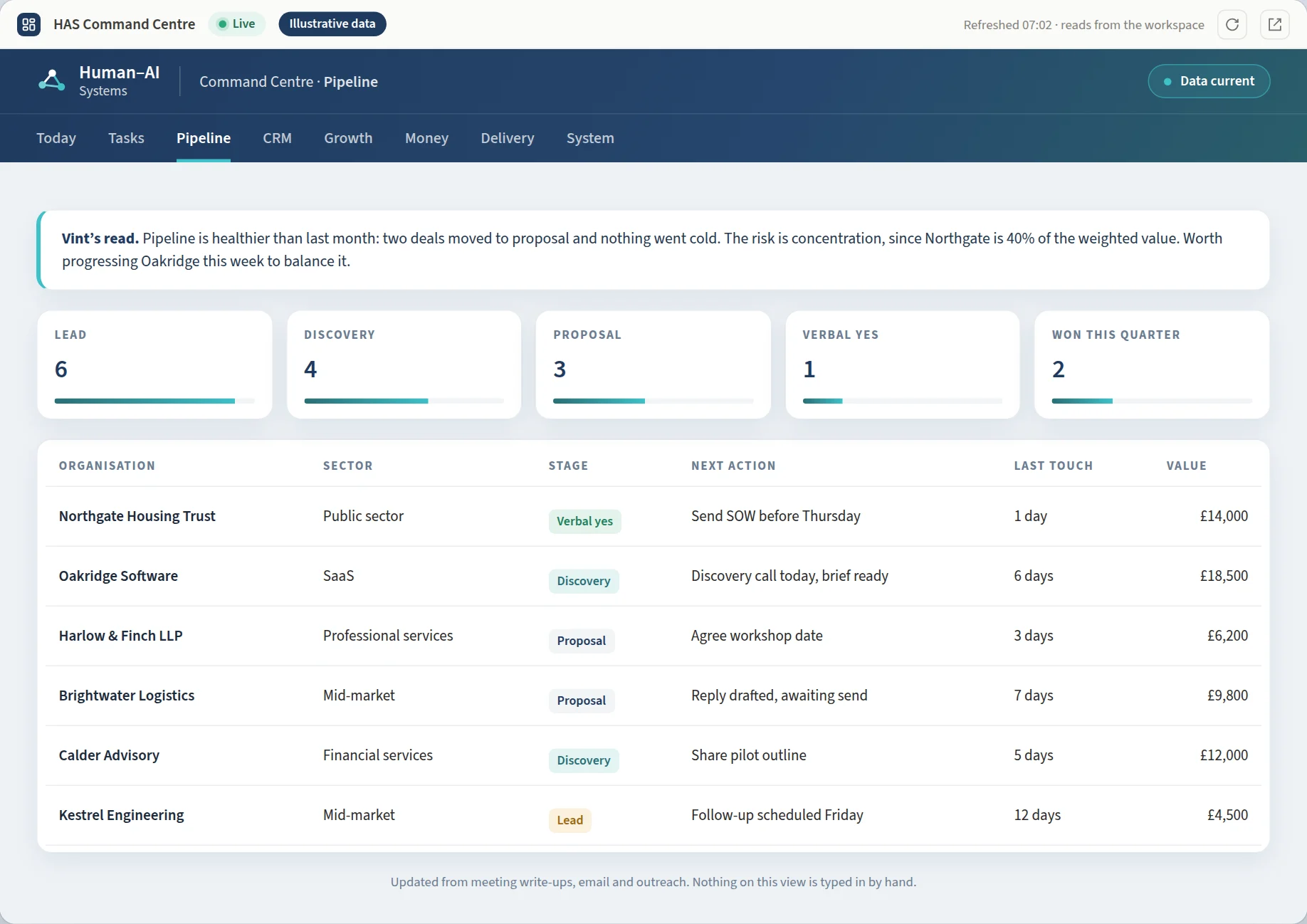
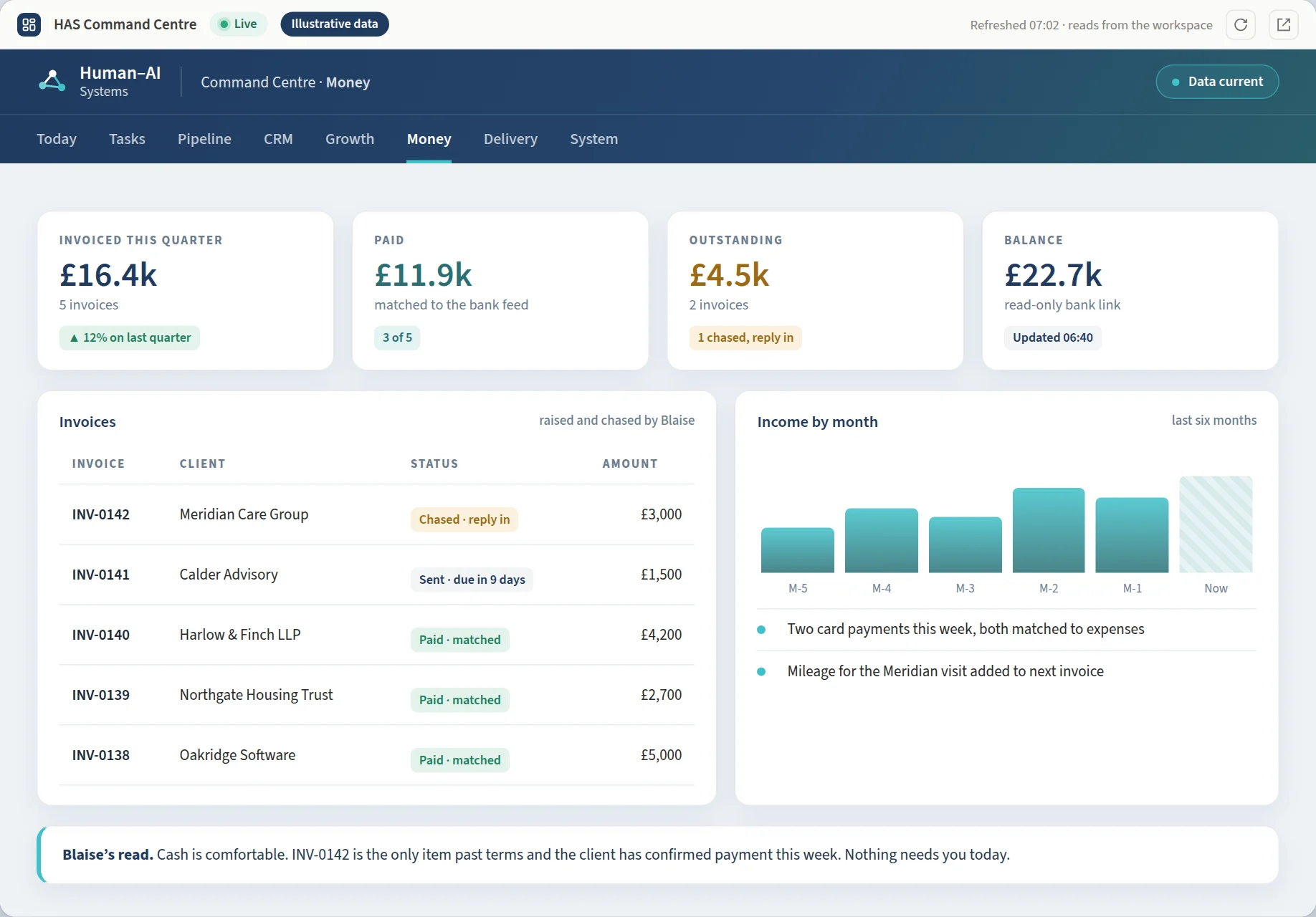
The dashboards are live pages the AI team keeps current from the workspace: what needs me today, where the pipeline stands, the money, and whether the system itself is healthy. Each one comes with the team’s own read of what the numbers mean. These are recreations with illustrative data, not our real figures.
An AI team, each with a job.
A skill is a written-down way of doing a job well, in our context, every time. The easiest way to understand them is as colleagues. Each one has a name, a role and clear limits on what it does alone.
The whole business, not one clever tool.
These are the parts people ask about most. Each one draws on the same knowledge base, which is why they work better together than any one of them would alone.
An EA who knows the business, not a note taker.
Online meetings come in as recordings and transcripts. In-person meetings and events are captured with Voice Memos and transcribed on the device. A standard note taker summarises what was said. This reads the transcript against everything already known: who the organisation is, where they sit in the pipeline, what we discussed last time, and what we offer.
What comes back is a write-up that understands why the meeting mattered, with actions in the task list, recommended next steps, the CRM updated, and anything of lasting value added to the knowledge base.
A CRM I never update by hand
Contacts, organisations, pipeline stages and next actions are updated as a by-product of the work, after meetings, emails and outreach. The CRM is used as well as kept: pipeline reviews, meeting briefs and proposals all draw on it, and it checks rules before anyone is contacted, such as opt-outs and never chasing the same person twice.
From discovery to proposal
Before a meeting there is a brief on the organisation, the people and the history. Afterwards, Alan turns what was learned into a situation analysis and maps the workflows against our Tool, Assistant, Worker model to shape the solution. Margaret drafts the proposal on our template from that analysis. Pricing follows one written method, and I make the call.
An AI CFO
Blaise raises invoices from the engagement terms, sends them, tracks payment and chases politely when something is overdue. A read-only link to the business bank account means he sees real transactions and the balance, so payments are matched and expenses picked up from actual activity. The figures sit on the same dashboard as the pipeline. Nothing that spends money happens without me.
Someone to keep me honest
In a one-person business nobody tells the founder when they are busy on the wrong things. The AI coach runs a daily focus brief and a weekly review against written goals, acts as a sounding board on difficult decisions, and pushes back when priorities drift.
One brand guide, applied everywhere
A single guide covers how we sound and how we look: language, tone, a list of phrases that make writing read as machine-made, typography, colour and logo use. Every proposal, deck, post, graphic and web page is produced against it, so the consistency that usually slips first in a small business is enforced rather than remembered.
Built and run by the AI team
Linus built this website and maintains it: pages, deployment, analytics, forms and a scheduled health check. Routine improvements happen and are logged. New products, services or pricing wait for my approval. You are reading the result.
Research that compounds instead of disappearing.
Market intelligence is gathered automatically, every day and every week, and filed into the knowledge base without duplicating what is already there. When I need to understand something properly, a sector, a technology or a competitor, the research is done and kept as knowledge rather than handed over as a one-off answer.
If I find a YouTube video or an article worth keeping, I pass over the link. The transcript or text is pulled in, summarised and connected to what we already know. I can also ask what it means for us: whether it points to a better way to build, a change to how we go to market, or something to try with a client. The recommendation goes into the task list or the decisions queue.
What we run on is what we build.
The AI team does not only run Human–AI Systems. Linus builds for clients too. For a multi-home care provider regulated by the CQC, we stood up a custom Business AI Operating System on the tools they already use: their own knowledge base and policies, their own permissions, and no new portal for staff to learn.
- Custom skills, including a recruitment and onboarding assistant with human decision points, a policy assistant that quotes and cites the provider’s own policies, and a support assistant for the system itself
- Beyond the AI platform: Power Automate flows for email and integration, Microsoft Forms for structured input, scheduled overnight operations and written runbooks
- Every hiring decision stays with people. The system prepares, chases and records.
The first use case is one workflow. The operating system is the asset the client keeps extending.
How much it does without asking.
A written charter sets the rules. The default is autonomy: anything not on a short list gets done and logged, and I read the log when I choose. The short list is where a mistake would be expensive or hard to undo.
Done and logged
- Briefs, triage, filing and meeting write-ups
- CRM, task list and knowledge base upkeep
- Follow-ups and routine email, in our voice
- LinkedIn posting at a human pace
- Website fixes and improvements
- New skills and refinements to existing ones
Waits for me
- Anything that spends money or commits us legally
- Messages to named sensitive contacts, which stay as drafts
- New products, services or pricing on the website
- Opening email attachments
- Major changes to how the system itself works
Permissions are keys, not prompts. Where something must not happen, the preferred control is that the AI cannot do it, such as draft-only access, rather than an instruction asking it nicely. Trust is earned: a clean month on a task is the test for loosening a restriction. It is the same governance thinking we bring to clients, applied to our own business.
It did not arrive finished.
It was built in stages, each one earning the next. The founder story covers the early part in more detail.
- PromptsA chat window, briefed from scratch every time. Useful, and forgetful.
- A knowledge base and skillsThe business written down once, and jobs written down as skills, so every piece of work starts from what is already known.
- Work on a scheduleSkills running before they are asked, and writing what they produce back into the knowledge base.
- Autonomy with guardrailsA charter that says what the team does alone, a log of what it did, and corrections folded back into the skills so the same mistake is not made twice.
Where to go from here.
From Prompt to Autopilot
A programme that builds you the same foundation, a knowledge base, skills, a daily brief, dashboards and connectors, then teaches you to run and extend it. What you see above is how far that foundation can be taken.
Consulting and builds
Discovery, pilots and scaling across an organisation, or a custom operating system built around a specific workflow, like the care provider above.
Meet Lumen
A synthetic 400-person company where every leader and function runs on a Business AI Operating System. The same idea, at the other end of the scale.
Want to see it running?
Thirty minutes, no preparation needed. I will show you the system live, talk through what your week looks like, and be straight about which parts would help you and which would not.